

Interpretive Collection - Order Squamata
- Scott Lockhart

- Nov 11, 2025
- 5 min read
Suborder Serpentes
1.0 Pythonidae Family
Boelen’s Python - Simalia boeleni

Located in forested mountainous slopes of New Guinea.
Known to be difficult to find in the wild and are a rare species that is protected by local authorities.
Both arboreal and terrestrial.
Active at dawn and dusk.
Oviparous
Can lay up to 19 eggs at one time.
Will protect eggs for around 90 days until hatching.
Mating season starts in December which is early Spring in their locale.
Female will warm up eggs by using muscle contractions whilst coiled over them.
Hatchlings will survive alone after emerging from shells.
Carnivores that actively hunt, constrict and swallow their prey, small mammals, lizards and birds, whole.
These snakes eat pre-killed rodents and quails in captivity and feed about once a week as juveniles and every 10 days as adults.
Avid eaters so it is important to closely watch their food intake.
They require a setup size of 6ft x 3ft x 2ft for their enclosure.
A substrate that absorbs moisture and retains humidity, like cork bark pieces, should be used.
Climbing branches and ornaments should be used to aid their arboreal tendencies.
Temperatures range from 37 degrees on hot side to 24 degrees on cool side during the day.
Humidity should be in excess of 70%.
Adequate sized water bowl and UVB lighting should be provided for general health.
2.0 Elapidae Family
Philippine Cobra - Naja philippinensis

Found in the northern islands of the Philippines in a range of different habitats such as forests, mountains and farm land.
Highly venomous and will spit toxins when attacked, cornered or paralysing prey.
Terrestrial predominantly but can climb and swim.
Mostly Diurnal but will hunt at night if in cooler temperatures.
Female lays around 30 eggs in natural hides such as dense jungle or crevices in the ground and guards them for around 70 days.
Hatchlings are venomous on birth and can be around 30cm long.
Mammals such as small rodents and small reptiles are all part of their diet.
Large 10-foot length and 5-foot width tank needed
Temperature gradient of 25-35 degrees.
Substrate used should be easy to clean and promote humidity.
Hardscape should enrich the snake’s life like a basking spot and branches for climbing.
Water bowl made available so they can bathe and drink water from.
Feeding once per week or bi-weekly depending on the size of prey.
Small rodents and small reptiles should be used to feed them in captivity.
3.0 Viperidae famiy
Acuminate Bush Viper – Atheris acuminata
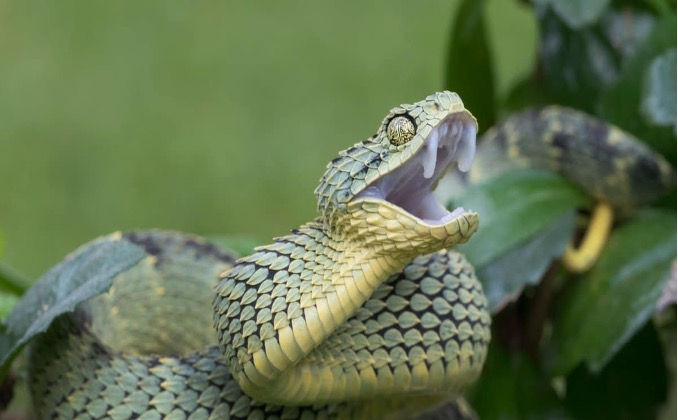
Gets its name from the tapering scales along its body and head.
Lives in Western Uganda within tropical forests.
It is a small sized species with animals reaching around 17 inches in total length.
As an arboreal species, it likes be high up in the canopy and wait for prey to come along.
Nocturnal activity allows this species to hunt at night.
Ovoviviparous – holds eggs inside their bodies for around 3 months.
May breed during seasonal changes.
Known to use their venom to incapacitate and eat small lizards including snakes, frogs, mammals and birds.
They require a medium-sized enclosure of around 24”X24”X36” dimensions.
A lot of branches, perches and cork bark rounds are needed for them to climb on.
Natural substrate like Reptisoil is good to maintain moisture and high humidity.
Daily misting for them to keep hydrated or provide an adequately sized water bowl.
Good ventilation as too wet of an environment may lead to respiratory issues.
Temperatures of 30 degrees on the basking area and 25 degrees on the cool side at all times.
Daylight cycles are required to mimic behavioural patterns.
4.0 Boidae Family
Green Anaconda - Eunectes murinus

World’s heaviest snake that can weigh up to around 230 kilograms (about the same size as a large refrigerator)
Mainly found in South America along freshwater environments such as marshes, swamps and flowing sources of water.
Stays mostly in an aquatic setting.
Nocturnal species that hunts at night.
Numbers have dwindled due to a human fear-factor and habitat destruction.
Ovoviviparous – holds eggs inside their bodies for around 7 months.
Parthenogenesis is also found in females but this is not the usual form of their reproduction
Litters can be large with around 80 live young being born.
Mating season would be around March to May (dry season).
Females will eat smaller males to tide her over through the gestation period and won’t eat until after.
Hatchlings are able to hunt and swim at birth.
Eats large mammals, reptiles, birds and fish and hunts by sitting and waiting in shallow waters.
Constricts and consumes prey whole by unhinging its jaw.
Anacondas require a huge enclosure of around 10 feet in length and 5 feet in height for a singular animal.
Large water area is needed with proper filtration and heating.
Warm side should be around 33 degrees and cool side being 27 degrees.
UVA/UVB light not required but can improve health
High humidity is required to reach around 70 percent with 100 percent readings being needed at night
Substrate should be coco coir or anything similar that can keep humidity levels high
Feed large prey such as chickens in lower frequencies as the snake ages.
5.0 Colubridae Family
Banded water snake or Southern Watersnake - Nerodia fasciata

Present in bodies of water of the Southern United States.
Move between land and aquatic surroundings.
Active during day and night.
When threatened they may release musk, flatten their body or bite.
Ovoviviparous and females hold babies for around 80 days of a gestation period.
Mating season occurs around April to June after both sexes have hibernated.
Around 50 babies are produced
Males and females meet the water to mate
Prey includes everything water based such as fish and amphibians
Swallows prey whole but doesn’t constrict them to death
This species requires a large paludarium that accommodates both land and water
A hygienic substrate such as newspaper would be good to use for ease of cleaning
Basking area should have rocks or branches and be around 30 degrees.
Cool side should be around 20 degrees during the day.
Water area should be large enough for the snake to full submerge
Feed them fish, mice or amphibians with vitamin supplement as frequently as it is in line with their environmental influences .
Comments